What Is an AI Product Marketing Platform?
An AI product marketing platform runs the entire product marketing function on one shared, always-current knowledge base. What it is, and why it needed AI.
Short on time?
Summarize it with your favorite AI tool.



An AI product marketing platform is one system that runs the entire product marketing function, from research through positioning, launches, and enablement, against a single shared knowledge base, so the work stays current without a person re-running it. It is not a competitive intelligence tool with a chat box bolted on, and it is not a stack of point tools sharing a login. It is the whole product marketing workflow, connected, so a signal found anywhere shows up everywhere it should. This page defines the category: what it covers, why it could not exist until now, and what makes it a platform rather than a bundle.
What is an AI product marketing platform?
Start with the plainer term inside it. A product marketing platform is one system that covers the full set of jobs a product marketing team owns, from research and audience through positioning, launches, campaigns, and enablement, instead of a separate tool for each. Sales has had this for decades in the CRM. Product marketing has not. What a PMM buys today is a shelf of point tools, each owning a corner and leaving the handoffs between them to a person.
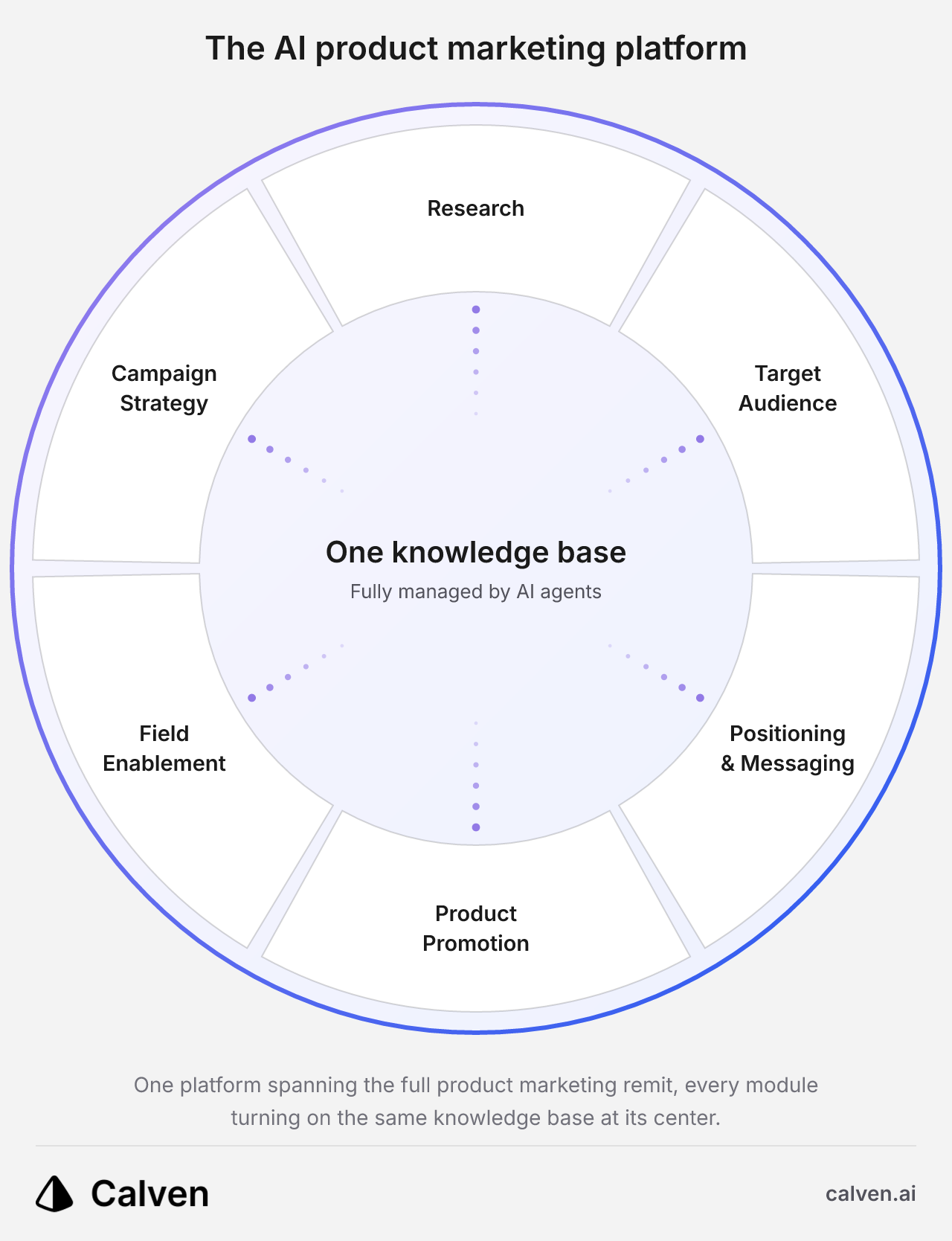
The AI version adds the part that makes the coverage worth having. Software that only stores the work still leaves a person to move it between the pieces. On an AI platform the work runs against one shared base and stays current without anyone re-running it. Full coverage is what makes it a platform. Keeping that coverage connected is what makes it useful, and that connection is the part that only became possible recently.
What does a product marketing platform cover?
Start from the job, not the software. A product marketing team owns a connected chain of work, and a platform holds every link of it on one base. Those are the six functions in the diagram above, covered in one place instead of one tool each.
Research watches the market, the competitors, and the reasons deals are won and lost. Target audience defines who the product is for, the ICP and the personas behind it. Positioning and messaging decide how the product wins and turn that into the words that land. Product promotion takes it to market, from launches to the pages and collateral that carry it. Field enablement arms sellers with the battle cards and one-pagers they open inside a deal. And campaign strategy shapes the story the demand team runs on.
Point tools cover one of these and hand the seams back to you. A platform runs all six against the same base, so a claim that research turns up reaches the positioning, the messaging, and the field without a person carrying it across. That connection is the whole point, and holding it together by hand is exactly what never lasted.
Why couldn’t this category exist before AI?
Here is the question that explains the timing. If the whole function held together is so clearly better, why did no one build a product marketing platform before? Sales got a CRM decades ago. Product marketing got a shelf of point tools and a person to hold the seams.
The answer is that a product marketing platform without AI holds together only by heroics, so no one built it as a product. Connect every function in one base and you have also created a coordination job. Someone has to read every call transcript and pull out what matters. Someone has to notice a competitor’s move and decide which battle cards it touches. Someone has to check that the messaging a draft inherited is still the current one. A determined PMM can do all of this by hand, and plenty have, with a wiki and a lot of late nights. It just decays the moment they stop, because the whole function held together by one person is a second full-time job pretending to be software. The connected design was always the better one. It was simply unsustainable to run by hand, so the market settled for tools that each did one slice and asked a person to carry the rest.
Automation is the first thing that removes that coordination cost at scale. A Voice of Customer Agent reads every transcript, so the knowledge is captured instead of lost between calls. A built-in feedback loop pressure-tests each draft against the current positioning and personas, so the connected work validates itself instead of drifting out of sync. And because the base is reachable over MCP, from inside the AI tools a team already works in, like Claude, ChatGPT, or Cursor, the platform is not one more dashboard someone has to remember to open. Take any of those away and the platform collapses back into the manual coordination that made it decay before.
So the category is not new because someone finally thought of it. The idea is old. It is new because the thing that makes it hold together, work that runs the function and keeps it connected without a person carrying it, did not exist until now. The first platforms to cover the full function are arriving already AI-native, with no manual, pre-AI version to replace, and Calven is one of them.
For years the best parts of product marketing stayed buried under the busywork of keeping everything in sync. AI finally clears that away. What is left is the part I love: the thinking, the strategy, the storytelling.
David KolínekCo-founder at Calven
What makes it a platform and not a bundle?
What makes it a platform is the shared knowledge base underneath it. Every function reads from and writes to the same base, so a change in one place moves to the others automatically, with no one carrying it across. A competitor’s move flags the positioning for review. A shift in the positioning updates the battle card that still quotes the old line. That automatic propagation is the line between a platform and everything it gets confused with. A CI tool watches competitors and hosts cards. A messaging tool drafts copy. A martech listicle lists both and leaves the wiring to you. A platform is the whole function on one base, connected once and kept in sync on its own.
There is a second reason the category matters now. As Wharton’s Stefano Puntoni argues, AI agents are beginning to act as buyers and shortlist vendors themselves (HBR, 2026). When a machine reads your positioning to decide whether you make the list, a version that is current and consistent everywhere stops being hygiene and starts being the whole game. That consistency is exactly what a connected platform protects and a shelf of point tools cannot.
What does “connected” actually look like?
Concrete beats abstract, so walk one chain end to end, with Calven as the example. A Voice of Customer Agent reads a win/loss call transcript and pulls the quotes worth keeping out of it, then sorts them by who needs them. The line where the buyer repeats a rival’s pitch goes to the Competitive Intelligence Agent. The line where the buyer describes what they were actually trying to fix goes to the Personas Agent. Each agent takes its quotes and updates what it owns. The CI agent revises the battle card that rival appears on. The personas agent rewrites the persona’s description to match how the buyer actually talks, and because that persona changed, the Messaging Agent reworks the messages that leaned on the old version.
One transcript, and the competitive card, the persona, and the messaging all move, each by the part of the platform that owns it, all against the same base. The edits land as changes you approve, or, once you have moved the dial, ones that ship on their own. That is the shape of the category, and the speed of it is what tracks to revenue. Teams that share competitive intelligence weekly or faster report revenue impact at 79%, against 41% for teams that share monthly or slower, per Crayon’s 2026 State of Competitive Intelligence report. The gap is not in what they detect. It is in how fast what they detect reaches the deal. When you are ready to weigh one platform against another, the small-team buyer’s guide turns this into the questions to ask and the red flags to watch. The test is the same one every platform has to pass: does a signal reach the work that depends on it, and can you set how much runs without you. Collection was never the hard part.
Where does the category go from here?
The category is early. Its definition is still unsettled, and most teams are still working off a shelf of point tools. What changed is that the technology to run the connected version finally exists, so the constraint that kept the platform theoretical is gone.
2026 is when that starts to land. The teams adopting first are not only swapping one tool for another. They are changing how the work moves: the base holds the positioning, the personas, and the competitive picture, and the updates travel across the function without a person shuttling them. That is a shift in how a product marketing team operates, not just what it buys. The platforms exist now. What is still being decided is how quickly teams reorganize their work around one.
We are glad to be at the front of that shift at Calven. If it goes the way we think it will, the win is not one more tool in the stack. It is product marketers spending their days on the parts of the job worth loving.
Frequently asked questions
What is an AI product marketing platform?
One system that runs the full product marketing function, from research through positioning, launches, and enablement, against one shared knowledge base, so the work stays current without a person re-running it. It is defined by scope (the whole function in one place) and connection (a change in one area reaches the others on its own), which is what separates it from a point tool or a bundle.
Why didn't product marketing platforms exist before AI?
Because a product marketing platform without AI holds together only by heroics that decay the moment one person stops. Connecting every function in one base creates a coordination job no small team can sustain: someone has to read every transcript, notice every competitor move, and check that every draft inherited the current positioning. Automation removes that coordination cost, so the connected design only became sustainable once the work could run on its own. That is why the first real platforms are appearing now.
What does an AI product marketing platform cover?
The full product marketing function rather than one slice: research, target audience, positioning and messaging, product promotion, field enablement, and campaign strategy, each run against the same base. A point tool covers one of these and hands the seams back to you.
How is it different from a competitive intelligence tool or a bundle of point tools?
A CI tool watches competitors and hosts battle cards. A bundle is several tools sharing a login. A platform holds the whole function on one base and connects it, so a competitor's move flags the positioning and updates the battle card without a person carrying it across. Judge it on connection, not on how many tools it appears to replace.
David Kolinek is the co-founder and CEO of Calven. He spent nearly a decade at Ataccama, a B2B data management company, rising from product design to VP of Product and then VP of Product Marketing, where he lived the gap between the strategic work PMMs sign up for and the tactical grind that replaces it. He writes about product marketing, competitive intelligence, and how small teams put AI to work without the busywork.
Connect on LinkedInRelated resources
An AI Product Marketing Platform: A Small-Team Buyer's Guide
How to evaluate an AI product marketing platform: a vendor-neutral checklist that tests propagation and autonomy, built for one-to-two-person PMM teams.
How AI Is Changing Product Marketing (and Why It Won't Replace PMMs)
AI won't replace product marketers. It fixes a chronically understaffed function and makes positioning matter more. Four shifts, honestly assessed.