Best Competitive Intelligence Tools for PMM Teams (2026)
Calven, Klue, Crayon, Kompyte and three more CI tools scored on eight criteria for PMM teams, with sourced prices and the work each still leaves to you.
Short on time?
Summarize it with your favorite AI tool.


Competitive intelligence tools now come in two kinds: legacy platforms like Klue, Crayon (crayon.co) and Kompyte, built around a person who curates, and AI-native tools like Calven, where agents do that work. This guide compares seven of them for product marketing teams. For each one you’ll see who it suits, what it costs and what it won’t do for you. Competitive intelligence is one category of the wider product marketing software stack; this page goes deep on that category.
What kinds of competitive intelligence tools are there?
The market splits into four kinds of tool, and knowing which kind you’re looking at explains most of the differences between them.
| Kind of tool | Examples | What it does |
|---|---|---|
| Legacy CI platform | Klue, Crayon, Kompyte, Contify | Collects competitor news and changes in one place; a person turns them into battle cards |
| Monitoring tool | Visualping | Tells you when a specific page changes, and stops there |
| General AI assistant | ChatGPT, Claude | Does the research if you build the prompts and keep them running |
| AI-native platform | Calven | Agents keep the research and the cards current while a person reviews |
Buyers usually shortlist the legacy platforms, and those are hard to tell apart for a simple reason: they watch the same things. Competitor websites, pricing pages, review sites, job posts and news all flow in. Collecting that is the easy part. The hard part comes after the alert, when someone has to decide whether a change matters and then fix the battle card a rep will open mid-deal. Each of these platforms leaves that to a curator. Their newer AI features help that person, but the person is still the engine.
That’s also where PMMs say the tools fall short. In Wynter’s May 2026 survey of 101 B2B SaaS product marketers, sales calls were the top source of competitive intel at 44%, while dedicated CI tools came in at 14%. And 82% said their battle cards go stale within six months. Market intelligence is a separate class again; competitive intelligence vs market intelligence maps where each one stops.
How do the best competitive intelligence tools compare?
We rated every tool on eight things a PMM team needs from it: the seven from our guide to evaluating CI tools, plus win-loss.
- Cards update themselves. A competitor’s change reaches the battle card without someone rewriting it.
- It filters the noise. The tool tells you which changes actually matter.
- It knows your deals. It connects to your CRM and sales calls.
- Easy to reach. People can pull intel from Slack or Teams, and AI assistants get the full content over MCP, not just a slice.
- You set the autonomy. You decide how much it does without your approval.
- Reps see updates fast. A change reaches the field quickly.
- The real cost is low. License plus the hours of whoever runs it.
- It explains wins and losses. It runs win-loss analysis, so you learn why you win or lose against each competitor.
The last one matters more than it looks. A battle card says how you plan to beat a competitor; win-loss tells you whether it’s working, from the buyers who just chose. Competitive intelligence without it is guesswork about your own deals, yet most CI tools leave win-loss to a separate vendor or a spreadsheet.
A tool gets full credit on a criterion if it clearly meets it, half if it partly does and none if its public materials don’t show it. Its score is the share of full credit it earns across all eight. We read every vendor’s public materials on 5 September 2026. Calven publishes this page and chose these criteria, so weigh the answers against your own team’s needs.
| Tool | Best for | Price | Score |
|---|---|---|---|
| Calven | PMM teams that want CI, win-loss and customer voice in one place | From $99 a month; teams from $9,600 a year (pricing) | 88% |
| Contify | Enterprise market and CI hub | About $12,000 to $30,000 a year (estimate) | 25% |
| Crayon | Cross-functional CI, widest monitoring | About $30,000 a year (details) | 38% |
| Klue | Sales-led teams with a curator | About $30,000 a year (details) | 63% |
| Kompyte | Small and mid-sized teams, no analyst | About $10,000 to $25,000 a year (estimate; details) | 31% |
| Visualping | Page-change alerts | Free, or $14 to $350 a month | 19% |
| ChatGPT or Claude (DIY) | Teams already on Claude Max or ChatGPT Pro, with no CI budget | About $200 a seat a month (top plan) | 31% |
Calven is the only CI platform here that publishes its prices, so its figures are exact. For Klue, Crayon, Kompyte and Contify, the numbers are estimates. Klue and Crayon figures are the median of what buyers paid on Vendr (read 1 September 2026). Contify and Kompyte have no Vendr data, so theirs are third-party estimates (marketintelligencetools.com for Contify, Parano for Kompyte as a standalone purchase); treat them as a starting point for the quote, not the quote.
How each tool scored, criterion by criterion
| Tool | Total | ||||||||
|---|---|---|---|---|---|---|---|---|---|
| Calven | 88% | ||||||||
| Contify | 25% | ||||||||
| Crayon | 38% | ||||||||
| Klue | 63% | ||||||||
| Kompyte | 31% | ||||||||
| Visualping | 19% | ||||||||
| ChatGPT or Claude (DIY) | 31% |
Which are the best competitive intelligence tools for product marketing teams?
Calven comes out on top at 88%. Klue is the strongest legacy platform at 63%, and the only one with a full win-loss module, including human-led buyer interviews. Crayon follows at 38%, and the Calven vs Crayon comparison goes through the gap. Kompyte and a DIY ChatGPT or Claude setup land on 31%: neither runs win-loss, and neither shows how a competitor’s change reaches the battle card without a person rewriting it.
Calven: AI-native, and the top score
Unlike the others here, Calven isn’t a typical CI platform. It started as an AI product marketing platform, a new category that runs the whole product marketing function on one knowledge base, and competitive intelligence is one piece of it. That’s why its battle cards draw on the same evidence as its win-loss, customer voice and market research.
Its Competitive Intelligence Agent finds your competitors, writes a dossier on each and watches their websites and docs. When something changes, it updates the dossier and builds the battle card from it. Every update waits for your approval by default, and you can switch approvals off once you trust the output.
It suits any product marketing team that wants current battle cards without a curator keeping them up by hand. Win-loss is built in: the Win/Loss Agent runs the buyer interviews itself, by online survey or AI voice interview, and explains each deal and the patterns across them. One thing it doesn’t offer is human-led win-loss interviews; if you want a person running those calls, pair it with a service.
Contify: a market intelligence hub first
Contify gives enterprise strategy, product, marketing and sales teams one shared hub, with unlimited users. It says its battle cards are “dynamically updated” by AI but doesn’t explain how, and while it lists win-loss insights for sales, it describes no way to actually interview buyers. Contify vs Klue sets it against a sales-facing tool.
Its strength is breadth for a large organization. It filters news and updates by company and theme, summarizes them with its Athena AI and sends them out by email and Slack as they happen. In September 2026 it upgraded its MCP server so ChatGPT, Claude, Gemini, Copilot and Perplexity can read its analyzed insights, with citations. Reviewers mention a learning curve and time spent tuning it to each team. There’s a 7-day free trial, and pricing comes through a demo.
Crayon: the widest net, if someone tunes it
Crayon monitors more sources than any other legacy tool here, which suits cross-functional CI as long as someone filters the volume. Some reviewers say the alerts get noisy. Its MCP server and APIs let other tools read its data, but nothing public shows them writing back or asking for approval, and there’s no managed win-loss service. The company is smaller than it was, too: LinkedIn shows about 70 employees in October 2026, 26% fewer than two years earlier. More in Crayon versus Kompyte and Crayon alternatives.
Klue: the strongest legacy platform
Klue is at its best in a sales-led team on Salesforce, where enablement owns CI and win-loss matters, and someone has time to curate. Its MCP server, announced in December 2025, lets an agent create and update cards and “suggest content improvements for human approval”. Its Win & Loss Story Agent works from “CRM data and call recordings”.
It’s also the only tool here with human-led win-loss interviews. Since buying DoubleCheck Research, Klue has its own researchers design and run buyer interviews, with AI summarizing the themes across them. If you want an experienced person asking buyers why they chose, that’s a real advantage, and it’s the one thing Calven doesn’t offer.
If Salesforce is your system of record, know the history. In June 2026, attackers used a forgotten Klue credential to steal OAuth tokens and pull data from customers’ Salesforce orgs, and Salesforce disabled the Klue app (The Hacker News). Klue announced on 27 July 2026 that Salesforce and Gong had reinstated the integrations, after an independent CrowdStrike review and tighter OAuth controls. The integration works again; ask Klue what changed and whether your data was affected.
Klue is also a smaller company than it was. In June 2025 it cut just over 40% of its staff, about 85 people, and CEO Jason Smith named AI as “the common thread”, with Klue losing deals to companies building their own AI tools (BetaKit). He said the aim was efficiency and a faster path to profitability, not a funding problem. LinkedIn shows about 190 employees in October 2026, 32% fewer than two years earlier. Before a multi-year contract, ask who will support your account and what’s on the roadmap.
The curator doesn’t go away, though. Klue’s own site promises customers can “triage new intel in minutes each day”, which still means someone does it every day. Reported prices are in Klue pricing. If you’re leaving it, Klue alternatives prices what a small team would switch to.
Kompyte: lighter, but the hours land on you
Kompyte suits a small or mid-sized team without an analyst. Onboarding, a customer success manager and integrations come included, which makes it the cheapest legacy option to run.
Its homepage says “an hour a week is all you need to track dozens of competitors”. An hour a week would be a good deal, but it’s hard to square with how the product works. With no public API or MCP, nothing outside Kompyte can take on the upkeep, and reviewers describe more than a light touch. “I never feel sure about how up to date the information is,” one Capterra reviewer wrote in 2023, and others report battle cards that still need hand work and news feeds that need tuning to cut irrelevant alerts. Win-loss isn’t built in either.
Kompyte’s owner, Semrush, now belongs to Adobe, and Adobe’s April 2026 announcement doesn’t mention Kompyte at all. More in Kompyte alternatives and Klue versus Kompyte.
Visualping: the alert, and nothing after it
Visualping tells you the moment a competitor’s pricing page changes. There’s a free plan, paid plans run $14 to $350 a month, and every plan includes an API and an MCP server. It won’t write a card or tell you which change matters to which deal, so it feeds a CI tool rather than replacing one.
It’s easy to start. The free plan watches 5 pages with 150 checks a month, and paid plans scale from 10 pages for one person up to 500 pages and 11 users on Business. Every change comes with an important-or-not flag and an AI summary, and a Reports briefing, added in March 2026, rolls them up. On Business plans, alerts can go to Slack or Teams. For a PMM, that makes it a reliable early warning on competitors’ pricing pages and terms, with someone still deciding what each change means.
ChatGPT or Claude: the DIY option
If you’d rather build it yourself, use whichever of ChatGPT or Claude your team already has. Both can run scheduled tasks in the cloud: a saved prompt fires every week, researches your competitors on the open web and rewrites a competitor document. Budget for the top plan, about $200 a seat a month (Claude Max or ChatGPT Pro, list prices, September 2026). The $20 entry plans run out of usage fast once you track several competitors every week, because each run reads competitor sites, docs and reviews and regenerates the whole document. On top of the plan, the real cost is the person who keeps the prompts working.
It’s a serious option. One enterprise Senior PMM in the Wynter survey said: “I can replicate most of what Crayon and Klue do with an agent in Claude.”
The limits show up over time. Each run is a black box: it starts fresh, rewrites the full document instead of changing what moved, and publishes with no review step, so nobody sees what changed or checks it before sales does. It can’t judge whether a change matters or reach gated sources like G2. ChatGPT and Claude for competitive intelligence goes deeper.
Win-loss is the bigger gap. ChatGPT or Claude can only analyze what you feed it, such as CRM notes from closed deals, and those notes are usually a line or two that say little about why a buyer chose. Real win-loss means interviewing the buyers, and neither tool will do that for you.
If your team already pays for Claude Max or ChatGPT Pro and has no budget for a CI tool, this is very likely your best option: it costs nothing extra and covers the basics for a handful of competitors. It stops working the day sales expects a current card in every deal.
Should you buy a standalone competitive intelligence tool in 2026?
You came here for the best competitive intelligence tool, and our honest answer is: don’t buy one. Not a standalone one, anyway.
Competitive intelligence is one of six jobs a product marketing team owns. The others are defining the target audience, positioning and messaging, promoting the product, enabling the field and shaping campaigns.
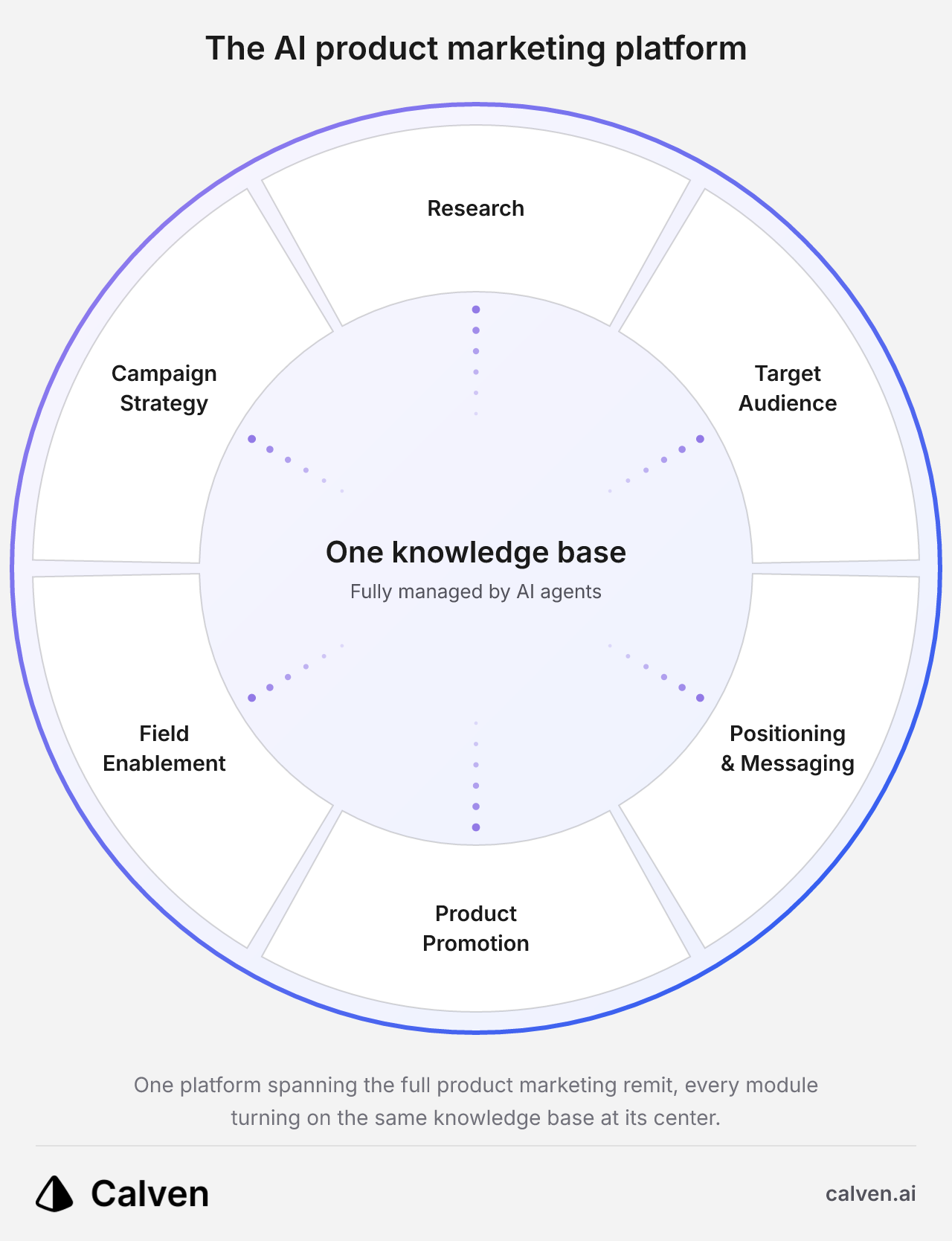
A competitor’s move only matters once it reaches the rest of that work: the positioning it threatens, the message that needs a sharper line, the battle card, the next launch. A standalone CI tool stops at the alert or the card. Every step after that is a person carrying it across by hand, which is exactly why cards go stale and the tool starts to feel like a second job.
Two things have changed. Collecting competitor information is now cheap; as that Senior PMM said, an agent in Claude does most of it. And AI agents can now keep connected work in sync, which no small team could ever sustain by hand. So competitive intelligence is fading as a discipline of its own and folding back into product marketing, where its output actually gets used. The tools built for that are AI product marketing platforms: one shared knowledge base for the whole function, with competitive intelligence as one part of it.
Why does Calven lead the list?
Because Calven is an AI product marketing platform, not a CI tool. Its competitive intelligence shares one knowledge base with the rest of the research a PMM team runs:
- The Competitive Intelligence Agent keeps a dossier and a battle card current for each competitor.
- The Win/Loss Agent runs online surveys or AI voice interviews with the people in a deal and explains why you won or lost, deal by deal and across deals.
- The Voice of Customer Agent reads your call transcripts and keeps what customers say in one place, with every quote traced to its source.
- The Market Research Agent tracks economic and industry trends and turns them into market opportunities.
You decide how much the agents do on their own: everything waits for approval by default, and you can turn that off once you trust the output. And because the knowledge base is reachable over MCP, your team can ask it questions from the AI tools they already use. The Calven vs Klue comparison takes the top two head to head.
Frequently asked questions
What are the best market intelligence tools?
For market intelligence, a wider job than competitive intelligence, AlphaSense leads on research depth, Contify on a centralized hub and Similarweb on digital market data. Business intelligence tools, which analyze a company's own data, are a different category again.
Is competitive intelligence legal?
Yes. Gathering public information about competitors is legal; the risk lies in how information is obtained, such as theft, misrepresentation or breaking a confidentiality duty. In the U.S., the Uniform Trade Secrets Act and the Economic Espionage Act of 1996 draw those lines, and the SCIP Code of Ethics is guidance rather than law. This is not legal advice, and rules elsewhere can be stricter.
Are there free competitive intelligence tools?
Yes, for monitoring. Visualping's free plan watches 5 pages with 150 checks a month, Google Alerts covers news, and ChatGPT and Claude have free tiers. None of them updates a battle card, so a person still turns each alert into something a rep can use.

David Kolinek is the co-founder and CEO of Calven. He spent nearly a decade at Ataccama, a B2B data management company, rising from product design to VP of Product and then VP of Product Marketing, where he lived the gap between the strategic work PMMs sign up for and the tactical grind that replaces it. He writes about product marketing, competitive intelligence, and how small teams put AI to work without the busywork.
Connect on LinkedInRelated resources
Competitive Intelligence Tools: 7 Buyer Criteria the Listicles Skip
Seven questions test what a CI tool does after it spots a competitor's move, and a break-even sum shows whether the license and the hours pay back.
Competitive and Market Intelligence Tools: Where Both Stop
Competitive and market intelligence get shortlisted together but serve different teams. What each does, who buys it, and the step neither covers.